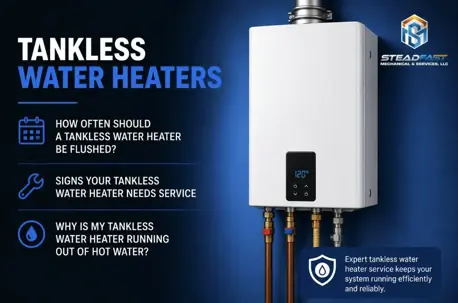
Tankless water heaters have become increasingly popular among homeowners because of their energy efficiency, compact design, and ability to provide hot water on demand. Unlike traditional tank-style water heaters, tankless systems heat water only when it is needed, helping reduce energy consumption while providing a virtually endless supply of hot water.
While tankless water heaters are known for their reliability and long lifespan, they still require routine maintenance and occasional service to perform at their best. Ignoring maintenance can lead to reduced efficiency, inconsistent water temperatures, error codes, and premature system failure.
Understanding how often a tankless water heater should be flushed, recognizing the signs that service is needed, and knowing why hot water problems occur can help homeowners protect their investment and avoid unexpected breakdowns.
HOW OFTEN SHOULD A TANKLESS WATER HEATER BE FLUSHED?
One of the most important maintenance tasks for any tankless water heater is routine flushing and descaling.
As water passes through the heat exchanger, minerals such as calcium and magnesium can accumulate inside the system. This buildup is commonly referred to as scale. Over time, scale restricts water flow, reduces efficiency, and forces the unit to work harder to produce hot water.
For most homes, manufacturers recommend flushing a tankless water heater annually. Homes with hard water may require more frequent maintenance depending on water conditions and usage.
Routine flushing helps:
- Remove mineral buildup
- Improve heating efficiency
- Extend equipment lifespan
- Maintain manufacturer warranty requirements
- Reduce the risk of performance issues
- Improve hot water consistency
Many homeowners are surprised to learn that tankless water heaters require more routine maintenance than traditional tank-style systems. While they offer significant long-term benefits, regular flushing is critical to keeping them operating properly.
WHAT HAPPENS IF A TANKLESS WATER HEATER IS NOT FLUSHED?
When maintenance is delayed, mineral buildup continues accumulating inside the heat exchanger.
As scale thickens, homeowners may begin experiencing:
- Reduced hot water production
- Longer wait times for hot water
- Fluctuating water temperatures
- Increased energy usage
- Error codes on the unit
- System shutdowns
- Premature component wear
In severe cases, excessive scale buildup can damage internal components and lead to costly repairs that could have been avoided through routine maintenance.
SIGNS YOUR TANKLESS WATER HEATER NEEDS SERVICE
Many tankless water heaters provide warning signs before a complete breakdown occurs.
Recognizing these symptoms early can help prevent larger problems and restore system performance before damage worsens.
INCONSISTENT WATER TEMPERATURES
One of the most common complaints homeowners notice is water that alternates between hot and cold unexpectedly.
While occasional temperature fluctuations can occur, frequent inconsistencies may indicate mineral buildup, flow restrictions, sensor issues, or internal component problems.
REDUCED HOT WATER OUTPUT
If your showers seem shorter than they used to be or your system struggles to keep up with demand, the unit may require maintenance.
Reduced performance often points to scaling inside the heat exchanger or restricted water flow through the system.
ERROR CODES ON THE DISPLAY
Modern tankless water heaters continuously monitor performance.
If an error code appears on the control panel, the system is indicating that service may be required. While some codes relate to simple maintenance needs, others may signal more significant issues requiring professional diagnosis.
LONGER WAIT TIMES FOR HOT WATER
Tankless systems provide hot water on demand, but unusually long delays can indicate maintenance concerns, flow issues, recirculation problems, or system performance declines.
UNUSUAL NOISES
Tankless water heaters typically operate quietly.
Popping, rumbling, clicking, or unusual operating sounds may indicate mineral buildup or internal component wear.
VISIBLE LEAKS OR MOISTURE
Any visible moisture around a tankless water heater should be investigated promptly.
Leaks can originate from fittings, service valves, internal components, or pressure-related issues and should never be ignored.
WHY IS MY TANKLESS WATER HEATER RUNNING OUT OF HOT WATER?
One of the most frustrating issues homeowners experience is a tankless water heater that suddenly seems unable to keep up with demand.
While tankless systems are often described as providing endless hot water, there are several reasons performance may decline.
MINERAL BUILDUP INSIDE THE HEAT EXCHANGER
Scale buildup remains one of the leading causes of reduced tankless water heater performance.
As minerals accumulate, heat transfer becomes less efficient, reducing the system's ability to produce hot water quickly and consistently.
EXCEEDING THE UNIT'S CAPACITY
Every tankless water heater has a maximum flow rate.
If multiple showers, appliances, and fixtures are operating simultaneously, the unit may struggle to keep up with demand.
In these situations, the issue may not be a malfunction but rather a sizing concern.
DIRTY INLET FILTERS
Most tankless systems include inlet screens designed to capture debris before it enters the unit.
Over time, these filters can become clogged, restricting water flow and affecting performance.
RECIRCULATION SYSTEM ISSUES
Homes equipped with recirculation systems may experience hot water delivery problems if pumps, sensors, or controls are not functioning properly.
COMPONENT FAILURE
Ignition systems, sensors, flow switches, control boards, and other internal components can occasionally fail and impact hot water production.
Professional diagnosis is often necessary to identify the root cause accurately.
HOW LONG DOES A TANKLESS WATER HEATER LAST?
One of the biggest advantages of a tankless water heater is its potential lifespan.
With proper maintenance, many tankless systems can last 15 to 20 years or longer.
Routine flushing, regular inspections, and prompt repairs can significantly extend system life and improve overall performance.
Without maintenance, however, even high-quality systems may experience reduced efficiency and shortened service life.
PROTECTING YOUR TANKLESS WATER HEATER INVESTMENT
Routine maintenance remains the best way to maximize performance and extend the life of a tankless water heater.
Annual flushing, professional inspections, and early attention to warning signs can help homeowners avoid costly repairs while ensuring reliable hot water throughout the year.
For homeowners in Charlotte, Fort Mill, Indian Land, Ballantyne, Waxhaw, Weddington, and surrounding communities, maintaining a tankless water heater is one of the simplest ways to protect comfort, efficiency, and long-term equipment performance.
If you've noticed inconsistent water temperatures, longer wait times for hot water, unusual noises, or declining performance, a professional inspection can help identify the issue before it leads to more significant repairs.
With proper care and maintenance, a tankless water heater can provide years of dependable hot water while helping improve energy efficiency throughout the home.